Showing posts with label Film. Show all posts

Monday, December 14, 2009

Horror Business Part Two: The Viet Nam Aesthetic

The early 1970s were a fertile ground for horror films in America. 1974 in particular was a real watershed year; not only did we get Bob Clark’s Black Christmas (my nomination for the title of “first American slasher movie,” predating John Carpenter’s Halloween by four years), but audiences were also treated to what might still be the scariest movie of all time: Tobe Hooper’s The Texas Chainsaw Massacre.

Loosely inspired by Wisconsin serial killer Ed Gein – the same case that inspired Alfred Hitchcock’s PsychoThe Texas Chainsaw Massacre still holds up because it feels so real. Featuring no-name actors, shot out in the middle of nowhere; you really feel like you could be watching someone’s last moments. The film features almost no onscreen bloodshed, but it was so effective that even the trailer was alleged to cause theater walkouts.

Texas Chainsaw wasn’t the first gritty, exploitative horror movie of the 1970s, though. It came hot on the heels of Wes Craven’s instantly infamous low-budget shocker, 1972’s Last House on the Left. Craven based his directorial debut on The Virgin Spring, a film by renowned Swedish director Ingmar Bergman – which was itself adapted from a medieval folk ballad, in what might be the most convoluted horror movie family tree of all time. The story of two parents avenging the rape and murder of their daughters by a roving pack of maniacs was, for its time, unprecedented in its graphic depiction of violence. Wes Craven has explained numerous times the role the Viet Nam War played in his conception of the movie:
“It […] was the era of Vietnam. And not to put too fine a point on it, I very much was influenced—and I think the whole country was kind of in a state of shock—for the first time seeing the horror and cruelty of war. Recently shot 16mm footage was coming back and appearing on television immediately, so there was little censorship of what you saw, and it was just appalling.” (1)
Craven’s film featured the infamous advertising tagline, “To avoid fainting, keep repeating – it's only a movie.” The unsettling implication being that you couldn’t do the same with news footage of American soldiers being killed.

From this point forwards, Viet Nam pervaded the horror films of the 1970s and early ‘80s. Tom Savini, the famous make-up artist who crafted the gore effects for Dawn of the Dead, Friday the 13th, and Maniac (among many others) got his start as a combat photographer in Viet Nam – leading to the extremely disquieting possibility that some of the painstakingly crafted corpses in those films are based on real corpses Savini encountered on duty. The ‘Living Dead’ of George Romero’s zombie movies can be seen as a metaphor for damaged troops returning home (although the Living Dead can be used as metaphors for basically anything – we’ll get into that later). And the deranged hitchhiker who kick-starts the action in Texas Chainsaw – in addition to bringing up fears of economic instability with his discussion of being laid off from the slaughterhouse – does have something of a brain-damaged veteran vibe to him (this implication would be made explicit in The Texas Chainsaw Massacre Part Two, where the hitchhiker was replaced with ‘Chop-Top,’ a literal brain-damaged Viet Nam vet with a metal plate in his head). Beyond the specific allusions, though, the emerging Viet Nam aesthetic meant not just more violence, but more of a personal and emotional toll to go along with that violence.

As horror moved further into the 1980s, the nasty subgenre of exploitation horror was gradually replaced by the equally exploitative, but overall more sanitized, slasher film. Sometime in the early years of the 2000s, though, some nasty, cruel, brutish and short horror movies started to sneak back in under the radar. Just as 1974 is arguably the most pivotal year in ‘70s horror, 2003 was the start of a new wave of 21st century horror. In the space of one year, horror fans got the deliriously gory French import High Tension, Eli Roth’s body-horror debut Cabin Fever, and Rob Zombie’s over-the-top serial killer flick House of 1000 Corpses. With their de-glamorized violence, desaturated color palates, and low-budgets, all three of these films evidenced a clear 1970s aesthetic influence. House of 1000 Corpses in particular is set in Texas in 1974, the same year the original Texas Chainsaw Massacre was released – and it shamelessly lifts so much from that movie’s plot and style that it could practically be considered a remake (even going so far as to cast the great Bill Mosely - the aforementioned 'Chop Top' from TCM 2 - as one of the lead villains; the sequel, The Devil’s Rejects, took a more original approach, and was consequently one of the best horror films of the decade). Just as in the 1970s, these films were clearly the start of a new trend. Later that year, there was the gruesome hillbilly slasher Wrong Turn, and in October, a pretty crappy remake of The Texas Chainsaw Massacre. The trend wouldn’t stop there, though, and where it led was even more culturally disturbing.

The double whammy of James Wan’s suspense-thriller Saw and Eli Roth’s extremely violent sophomore effort Hostel brought graphic scenes of torture to the forefront. These films attracted significant controversy - which, judging by Hostel’s provocative advertising campaign, was exactly what they intended - but they also raked in cash. Saw was made on a budget of just over one million dollars, yet it raked in over 100 million in combined theater and DVD dollars. And, like any low-budget horror flick worth its weight, it was followed by a string of increasingly terrible sequels (not that the original was particularly good in the first place, but the series rapidly descended from wild improbability into outright lunacy). Now, any movie with a plot designed to support a string of painful torture scenes has an intrinsically limited audience; the fact that the films are terrible either lessens or increases their chances of success depending on your opinion of the average theater-goer. So why did these films take off so incredibly?

For me, it once again comes back to the culture that produced them. Rob Zombie’s House of 1000 Corpses, one of the first of this new-wave of exploitation horror, came out on April 11th of 2003, less than 30 days after the US invaded Iraq. The movie, of course, had been in production long before that – in fact, it was all but completed three years prior, but was delayed due to fights with the MPAA ratings board over its graphic violence. The delay in its release ended up with the result that it came out just as public consciousness of a new war was reaching its fever pitch. If you want to take this line of thought even further, you can look at the specific wave of the so-called “torture porn” subgenre. Saw, the first of this particular trend, was widely released in October of 2004. Torture, too, was fresh in the American mindset: the news of the prisoner abuses in Abu Ghraib broke in late April of that same year. The post-Iraq American consciousness, much like the post-Viet Nam American consciousness, was in exactly the right place and time to foster a new, disturbing trend in horror.

It seemed as though 2007 would’ve been the perfect time for Quentin Tarantino and Robert Rodriguez to unleash their ambitious Grindhouse project on the bloodthirsty public. Grindhouse was a double-feature, 3-hour long homage to the sleazy, violent horror movies that Rodriguez, Tarantino, and many of the new decade’s horror filmmakers grew up watching. Robert Rodriguez’ half, Planet Terror, even featured one of the most knowing winks to the ‘70s style of exploitation film I’ve yet encountered: late in the film, Bruce Willis’ character reveals that his platoon was dosed with some kind of biological chemical shortly after they killed Osama Bin Laden on a mission in Afghanistan – were the film made in the ‘70s, you could easily see those details substituted for Agent Orange, Ho Chi Minh, and Viet Nam. A mix of zombie flick and slasher movie featuring guest trailers directed by guys like Eli Roth and Rob Zombie, overflowing with gore and stylish camerawork, it seemed that Grindhouse could do no wrong.

Until the box office returns came back, that is. Grindhouse had an 11.5 million dollar opening weekend, not even making back a quarter of its 53 million dollar budget. Two months later, Eli Roth’s Hostel: Part II would similarly bomb at the box office, with an opening weekend of 8.2 million, compared to the 19 million dollar opening weekend of the first installment – a number that Hostel: Part II would fail to gross in its entire theatrical run. The bubble, it seemed, had burst for the new wave of exploitation.

What it comes down to, in my opinion, is market saturation. If you flood the market with something to capitalize on a new trend, people will inevitably get sick of it. This is especially true with regards to the horror film, and specifically a subgenre of horror that relies so heavily on shock. If you see enough rote, by-the-numbers movies with people getting horribly mutilated, you almost immediately start to lose the key factor that made such films interesting in the first place: the element of danger. If you’re the first to come up with this violent new idea of gritty, downbeat torture flicks, you might seem like a provocative, edgy auteur. If you’re the fifteenth, though, you just seem like a businessman out for a quick buck. Which might be scary, but not in the way you intended.

Not that the trend is over-and-done-with. Last year saw a remake of Last House on the Left, and the Saw movies continue to get churned out on an annual basis. But to me, it seems clear that the exploitative torture genre is going through exactly what it subjects its characters to: a slow death.

Coming Up Next: An analysis of the decade in slasher films, and the dark mirror they hold up to the U.S. Economy - No, really - in Slashing the Budget.

(1 - Sourced from Wes Craven interview at http://www.avclub.com/articles/wes-craven,24869/)
(Poster images obtained via http://www.wikipedia.org)

Horror Business Part One: The Outsider

When discussing the idea of Genre in fiction, Horror could be called the black sheep of the family – or, perhaps more appropriately, the creepy little kid that you don’t want to turn your back on. The very idea of the horror story – a piece of fiction designed to elicit fear, terror, and other altogether unpleasant emotions – has always been a bit of a tough sell. With a rare few exceptions, you don’t see horror novels climbing the bestseller lists (unless they’re by Steven King) and you don’t see horror movies grabbing Oscars (unless its Silence of the Lambs). Good horror should be distressing on a very basic level. Horror has always been the outsider’s genre, and most people simply don’t want to hear about it. And when a horror story is put on film, with all the grisly details coming to life on celluloid, it becomes that much more powerful.

For these reasons, the horror film often comes under a lot of scrutiny. This can be seen a lot in the period from the late ‘70s to the mid ‘80s, from Siskel and Ebert’s furious televised tirade against the Friday the 13th series to the utterly hilarious parent-teacher protests of the infamous Santa slasher, Silent Night, Deadly Night. But, as with any form of art, telling people they shouldn’t see it is just going to make them want to even more, and it’s often the horror films with the least semblance of moral value that are able to take over the box offices.


All of this taken together has led me to the belief that no genre in film can tell you more about the culture producing it than the horror movie. Through its dark, subversive nature, the horror film reveals things that other genres can’t – or won’t – acknowledge. If Drama is classical and Romantic-Comedy is pop, Horror is punk-fucking-rock – and like punk rock, though it may attract protest and condemnation from many, it exposes some truths that are hard to deny.


In this series, I’ll be looking at the relation between the Horror film and society with a specific focus on the past ten years. All narrative genres have a tendency to be cyclical though, so I’ll also be taking a look at how the horror films of the 21st century mirror what came before.


In the next installment, I’ll be taking a look at the resurgence of the 1970s exploitation style of horror filmmaking, or what I like to call The Viet Nam Aesthetic.

Monday, November 23, 2009

Missing the Target: John Woo's Hard Target


It’s a strange axiom within film that bad movies are often far more enjoyable by good movies. I could cite the fact that I’ve seen classics like The Godfather and Casablanca once apiece, but I’ve seen Robot Monster at least a dozen times (That’s the one with the gorilla in the diving helmet. No, I'm not going to elaborate on that). Granted, watching truly terrible movies is not for amateurs. It’s been clinically proven as a link to alcoholism – and I’d argue it causes marijuana use too, but that’s a bit of a ‘chickens-and-eggs’ scenario. So you can be sure I took it very seriously when I went to my local library to seek out the worst movie I could find – on VHS, mind you, the way the true bad movie professionals do it. But, since picking on Batman and Robin is like picking on the crippled kid in gym class, I settled for the second worst movie I could find: John Woo’s Hard Target. I followed proper bad movie procedure: I called some friends, had a few drinks, and got myself ready. And by about five minutes in, I knew I’d done good.

The movie opens with a bunch of bad guys led by Lance Henriksen chasing down an unspecified victim through the back alleys of New Orleans. I was glad to see Henriksen in this one; he’s one of those really good actors who just keeps winding up in really bad movies. I’m not sure how you go from roles in Dog Day Afternoon, Aliens, and Near Dark to direct-to-video crap like Alone in the Dark II and Screamers: The Hunting, but hey, that’s Hollywood for you. Anyway, it turns out Lance and his cronies are one of those shady action-movie groups of wealthy tycoons that get together to hunt the deadliest prey of all – MAN! Yes, this is yet another adaptation of the classic Richard Connell short story “The Most Dangerous Game,” although as far as dead horses go, this one’s been beaten so often that you’d probably have to check its dental records to find that out. I also feel like these so-called ‘big game hunters’ kind of missed the point. I mean, there’s at least a dozen of them with motorcycles, machine guns, crossbows, and bazookas chasing after one unarmed homeless guy. Kinda takes the thrill out of the hunt, don’t you think. “If he gets to the river, he’s won. We cannot allow that to happen,” Lance helpfully explains. Really though, if he makes it to the river, they’re all gonna look like a bunch of fucking amateurs.

We go from the hunt to another bad movie veteran, Yancy Butler, arriving in New Orleans to try and track down her missing father. And I have to say, her performance is impressive in that I’ve never seen someone appear on screen for so much of a movie without ever appearing to act. She just sort of has that watching-paint-dry face in every situation. It’s like someone tried to teach a robot how to act and gave up halfway through. Her search leads her to Mr. Van Damme himself, introduced via a slow-motion close-up on the back of his glorious mullet. Now, one of my favorite things about Van Damme movies – and, trust me, I have a lot of favorite things about them – is that the filmmakers always try and come up with some background to explain his accent. But it’s never, ever the right one. Here, the muscles from Brussels plays Chance Boudreaux. Really, that’s his name. Trouble is, he doesn’t even try to sound Cajun whatsoever. It’s even worse than when he tried to play a French-Canadian in Sudden Death. So JCVD and whatshername decide to investigate the missing person’s case together and stumble upon… y’know, I’m just gonna stop right there. Nobody really cares about the plot to this, do they? We just want to see Van Damme kick some people in the face.

And oh boy, do we ever see him kick some people in the face. Another great thing about JCVD movies is that, since he built his career on kicking people really hard, all the fight scenes involve people attacking him in the most awkward, ungainly positions to leave themselves open for a face kick. I mean, when Van Damme can kick a guy off a speeding motorcycle, it doesn’t make him look badass, it just makes the biker look retarded. And since this is also a John Woo movie, the viewer gets to ponder such questions as: “Is it really necessary to kick somebody in the face after you’ve shot them five times?”

On that note, I’d like to observe a moment of silence for John Woo’s career. I don’t know if his IQ just dropped sharply once he left Hong Kong, but it’s simply stunning that he made this just one year after making one of the greatest action movies of all time, Hard Boiled. There are still plenty of his little trademarks, such as shitloads of slow motion, improbably placed doves flying everywhere, and lots of ‘seeing-things-in-reflections-of-other-things,’ but there’s not really much in the way of actual directing. Does America just have some sort of dumbening field around it or what?

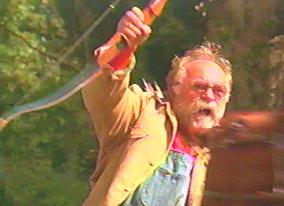
Anyway, about halfway through, my notes on the movie devolved into a simple catalogue of all the ridiculous shit that was happening. This is a movie where Jean Claude Van Damme punches a poisonous snake unconscious, then hangs it from a tree as a booby trap so it can bite someone in the face. This is a movie where Jean Claude Van Damme kicks a can of gasoline at someone, then shoots the can in mid-air, causing them to burst into flames – when he could have just shot him. This is a movie where people dive face-first through plate glass windows unscathed, everything bursts into flames when shot, and Ted Raimi shows up for a cameo (and when you even know who Ted Raimi is, you know you’ve seen too many bad movies). By the end of this movie’s six hours – I mean ninety minutes – I was frantically searching the back of the box for some kind of crisis hotline. Someone I could call and ask “how does the bad guy know that the train went by two and a half hours ago just by looking at a muddy footprint?” I guess I got what I paid for, though (it was free). Now I can show myself in front of fellow bad movie connoisseurs with pride in my heart and say, “Why yes, I have seen a movie where Wilford Brimley rides a horse away from an explosion wielding a bow-and-arrow.”

Did I mention Wilford Brimley’s in it?

Wilford Brimley’s in it.


(Poster image obtained via http://wikipedia.org. Brimley image obtained via http://www.edhumphries.com)

Sunday, October 18, 2009

Filmed In Spookyvision: Paranormal Activity


Oren Peli's Paranormal Activity, which has sat on the shelf awaiting release since 2007, is a movie that really tries its damnedest to scare the shit out of you. Every trick in the haunted-house genre is thrown at the screen with reckless abandon, from creepy footsteps to doors opening and closing on their own. There's even a paranormal investigator on hand to tell young couple Katie (Katie Featherston) and Micah (Micah Sloat) just how much trouble they're in (who ya gonna call?). Now, the problem is, none of this is very scary. But it tries so damn hard that it at least becomes endearing.

Katie has been, for lack of a better word, haunted by some sort of unknown presence since she was eight years old. She talks about it with a cool rationality for the most part, but from the beginning it's apparent that things are getting worse. Micah, ever the alpha-male, brings home a fancy video camera to try and capture some sort of evidence of the titular activity. And that right there is basically all the plot the movie needs to string together a series of creepy haunting scenes.

The device for these scenes is pretty clever. Micah sets up the camera across from their bed, and we're given labeled footage of roughly 21 nights. All of the 'action,' what little there is, takes place almost entirely in that one static shot, and the film gets a lot of mileage out of it. We always know something is going to happen, but it's different every time, leading to a lot of looking around the frame to see what the spirit will do this time.

The use of repetition in these scenes becomes both an asset and a liability. The sheer tension every time the camera shifts to that shot was palpable in the theater. The problem is, as I said before, these scenes are very rarely scary. A few of them are very, very creepy (including one that makes a brilliant use of time-lapse footage), and about two have a noticeable jolt to them (although jump scares really don't affect me as they once might've). After the second or third unexplained breeze, though, it starts to lose its impact. Furthermore, this movie is at least a good 15-20 minutes longer than it should be. Dropping a few of the milder stuff in the middle may have helped to make the transition from 'innocent poltergeist' to 'terrifying haunting' more jarring and, thus, more scary.

This movie has been, is, and will continue to be compared to The Blair Witch Project, and it's not unwarranted at all. From the creepy soundscape to the gimmicky opening and closing screens to the use of the actors real names - not to mention the first-person camera work - this one takes more than its share of cues from that film. The whole first-person gimmick has really taken off in the horror genre lately, and the results range from the fantastic (Blair Witch and the Spanish import [REC]) to the abysmal (George Romero's laughable Diary of the Dead and the painfully bad Cloverfield).

Even the best of these movies have issues to overcome, though, the most obvious being: Why the fuck don't these people ever put the camera down? Each film has tried to offer its own explanation (I'd say [REC] pulled it off best), from revealing a social injustice to an almost metafictional dedication to filmmaking. Paranormal Activity's solution to the problem is simultaneously very credible and pretty disappointing: Micah never puts down the camera because he's a bit of a stubborn, immature douchebag. The kind of guy who, after being told about seven times that the worst thing he could do is bring a Ouija board into the house, does exactly that. The kind of guy who thinks the haunting is "cool" even as his girlfriend is being driven to the brink of insanity. The kind of guy who, in a particularly nasty moment, tells Katie to "go upstairs and play with your little friend." I suppose it does play in nicely with the film's theme of negative emotions making the haunting worse, but it's also an example of one of my least favorite horror tropes: people doing stupid shit just to move the story forward. Still, Sloat gives a very believable performance in the role, and Featherstone is seriously impressive in what becomes a far more complex role than you might suspect by the end of the film.

Paranormal Activity may not live up to the inescapable hype, but despite its flaws, it's still a nifty little low-budget chiller. I have a real soft-spot for horror films that can do what they need to by relying on ideas, acting and camerawork instead of a big effects budget or big name stars. If he can move past the gimmick, I think Peli shows real promise as a horror director. It may not be out-and-out scary, but as I said, it is often very creepy, and most horror movies have trouble even accomplishing that.

Coming Soon in Movies: Friends of Eddie Coyle gets a second look.

(Poster image obtained via http://www.wikipedia.org)
Things to Do in Boston When You’re Dead: “Boston Noir” hits Cambridge, Copley.


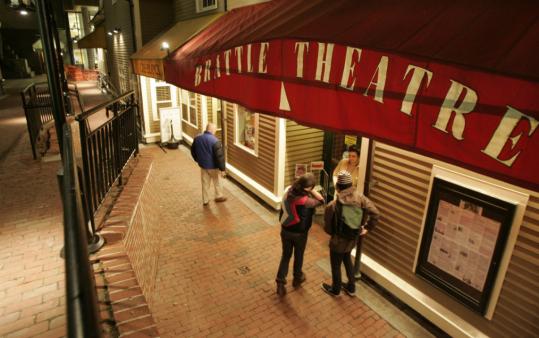
When one thinks of Halloween, it might call to mind costumes, parties, and seeing scary movies in the theater. This October, though, Cambridge’s famous Brattle Theater (located at 40 Brattle Street in Harvard Square) is putting together a different kind of film revival. “Boston Noir” kicked off this past Friday night, starting up two weeks of pulpy crime flicks set in and around Boston.

As to what sparked the idea of holding a repertory series like “Boston Noir”, it was brought on by the upcoming publication of the literary anthology of the same name, published by Akashic books, an imprint that specializes in like-minded collections in American cities ranging from Brooklyn to Phoenix. The newest entry in their Noir series is edited (and features a short story) by famed Boston crime writer Dennis Lehane (Gone Baby Gone, Shutter Island), and sports the neat gimmick of having each story focus on a different Boston neighborhood, from Dorchester to Cambridge. Lehane himself will be attending the Brattle at five pm on Sunday the 25th to sign copies of the book along with fellow contributors Jim Fusilli, Dana Cameron, Russ Aborn, and Lynne Heitman.

If you live in the greater Boston area and have somehow never been to the Brattle Theater before, you just have to go, and the Boston Noir series should serve as a fantastic, one-of-a-kind introduction. Any Bostonian who saw The Departed in its first theatrical run can attest to the sheer fun of going to a Boston theater to see the city on the big screen in all its dirty, gritty glory (hell, even the brief shout-out to Ted Williams in Tarantino’s recent Inglorious Basterds drew cheers when I saw it on the big screen). Plus, the Brattle just happens to be possibly the best theater in the area when it comes to showcasing vintage prints of really choice movies.

I attended day one of the Boston Noir festivities with a new archival 35 millimeter print of the 1973 classic Friends of Eddie Coyle on Friday. Peter Yates (of Bullit fame) directs fantastic tough-guy actors Robert Mitchum (Out of the Past, Night of the Hunter) and Peter Boyle (Taxi Driver, Hardcore) in a twisted tale of Beantown bank robbers and arms dealers. This once-forgotten film is a noir-lover’s dream, replete with all the standards: shifty crooks, themes of trust and betrayal, and plenty of moral shades of grey. Plus, it’s a veritable filmic treasure trove of familiar locations, with clandestine meetings taking place on the Common or Government Center while the down-and-dirty stuff happens out in Quincy, Dedham, and Weymouth. So pervasive is the film’s use of setting that I was almost surprised to step out of the theater and find myself back in 2009. If you missed the screening, this long out-of-print film was finally released on a typically high-quality DVD by the Criterion Collection.

I hadn’t been to the Brattle in at least a year or so (I forget what I last saw there – either the remastered print of Blade Runner or a Polanski double feature), but it’s nice to see it hasn’t changed much, and where it has is for the better. They continue to unveil new designs for posters and t-shirts that will have film geeks’ mouths watering (I noticed a particularly awesome day-glo poster for John Carpenter’s Halloween). And speaking of mouth-watering, they’re now serving select beers from the Cambridge Brewing Company at all shows after five pm. At $5.50 a pint, it’s a bit pricey, but the Porter is delicious.

“Boston Noir” at the Brattle will continue right up through Halloween (when they’ll make time for their annual screening of Evil Dead II), coinciding with the November 1st publication date of the anthology. Lehane and crew, in addition to their appearance at the Brattle, will also be making a stop at the Copley Square library for the Boston Book Festival on Saturday, October 24th to promote the new book. Upcoming films to be screened in the Boston Noir series include The Departed, Mystic River, Gone Baby Gone, The Brinks Job, and The Thomas Crown Affair.

(The Brattle Theater is located at 40 Brattle Street in Cambridge, MA. Ticket prices are $9.75 General Admission and $7.75 for students or at matinee showings. You can get more info at www.brattlefilm.org or by calling at 617-876-6837.)

Coming Soon in Books: Reviews of My Dead Body, The Shotgun Rule, and The Rebel

Coming Soon in Film:
A more detailed review of Friends of Eddie Coyle. Plus, tune in next time to find out if I shit my pants watching Paranormal Activity! The answer may surprise you!

(image "Boston Noir" by Francisco Marty obtained via http://www.boston24.com/article-1544-boston-noir.html. Brattle Theater image obtained via boston.com)

Wednesday, October 14, 2009

Zombies Ate My Neighbors! (But I didn't like them anyway): Zombieland


“What do you think?” asks zombie killer Tallahassee (Woody Harrelson) after blowing away the one remaining zombie in an abandoned storefront, “Zombie kill of the week?” This moment pretty perfectly encapsulates director Ruben Fleischer and Zombieland’s mission statement, and gives us the litmus test for whether or not you’ll enjoy the rest of the movie: If the idea of watching Woody Harrelson kill zombies in increasingly creative ways for roughly 90 minutes appeals to you at all, you’ll enjoy this film. It's such a simple concept that its hard to believe it hasn't been done before, and for fans of the genre, it's basically critic proof. Zombie movies have always been, to some extent, about seeing how creative the filmmakers can get with their kill scenes. Tom Savini and George Romero have gone so far to admit that some of the most memorable moments in Dawn of the Dead came about just because they were bored and had extra food at the craft services table. This is the first time, though, that I’ve seen a movie that made killing zombies its explicit purpose – and believe me, I’ve seen a shitload of zombie flicks.

What little plot the film has is of the basic road-movie/zombie film variety: a few random survivors of a zombie apocalypse try to make their way across the country to some kind of safe haven. We’ve got Columbus (Jesse Eisenberg), a nerdy college student who manages to survive not through skill or even luck, but through an obsessive compulsive attention to detail. There’s Wichita (Emma Stone) and Little Rock (Abigail Breslin), sister con artists who get by on their wiles alone. And, stealing the movie from all of them, there’s Woody Harrelson’s Tallahassee, a southern-drawling ultimate badass who seems to derive real joy from killing the undead. Harrelson plays the part as a variation on his role in Oliver Stone’s
Natural Born Killers, except here we can root for him since he’s killing zombies and not people. The plot takes all sorts of winding detours, including a 15 minute middle section that contains no zombies at all, but makes up for it with one of the funniest celebrity cameos I’ve ever seen (which I won’t give away here, and shame on anyone who does - fuck you, Boston Phoenix/Roger Ebert). It’s not flawless – like a lot of zombie movies, this one relies on a third act where smart characters do very dumb things solely to keep the plot moving forward. Really though, this is just a movie that everyone clearly had a blast making, and for dumb, hilarious Halloween entertainment, it’ll be hard to top.

Coming Soon in Movies: Arguably the greatest movie ever to be filmed in Boston, Friends of Eddie Coyle, which I'll be rewatching at the Brattle Theater in Cambridge on Friday. If you live in Boston and you haven't seen it, GO! When's the last time you saw Robert Mitchum hanging around Boston and not just some homeless guy that looks kind of like Robert Mitchum?

(Poster image obtained via http://www.wikipedia.org)